
Wildlife Depth of Field
Know before you press the shutter: will the eye be sharp, will the whole animal fit in the zone of focus – and if not, what is the one change that fixes it.
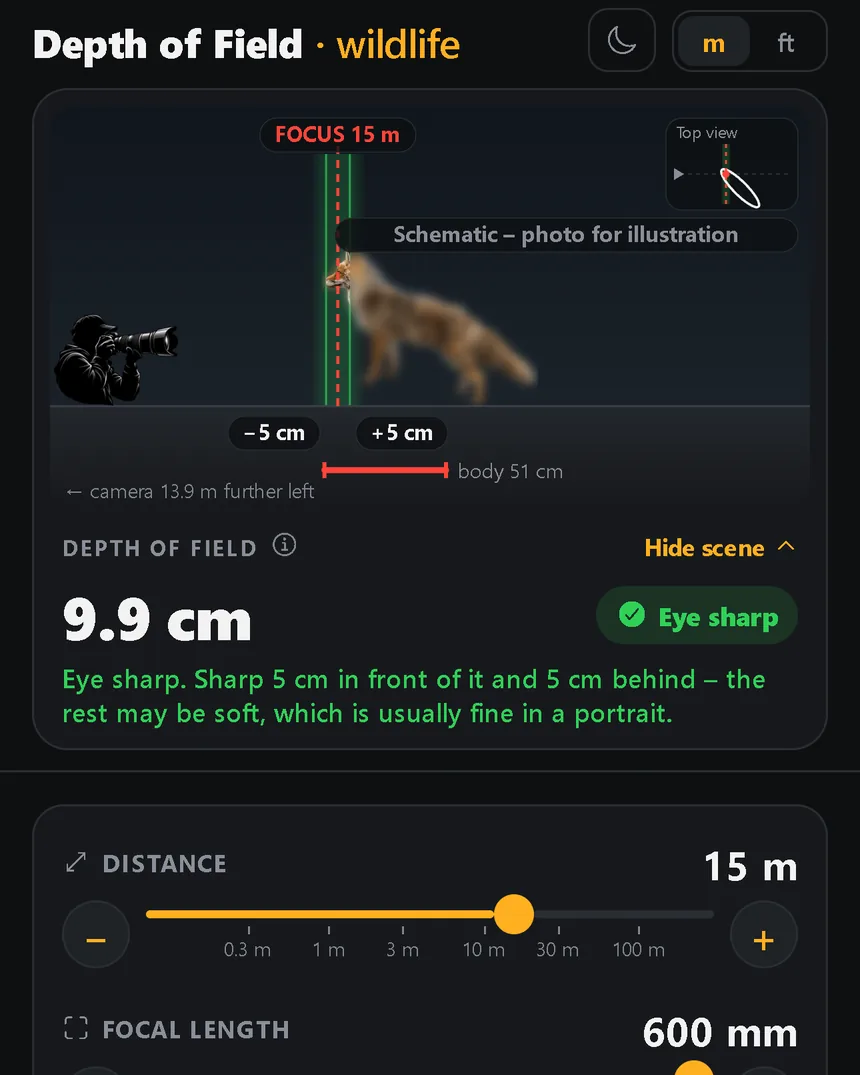
Made for photographing animals
- Eye or whole animal. Choose a portrait (the eye must be sharp) or the whole animal from beak or nose to tail. The camera focuses on the eye; the app checks what lies in front of it and behind it, head-on, at an angle or side-on.
- One concrete tip. If the result is not good, the app suggests one feasible change – turn to side-on, step back, stop down, zoom out or remove the teleconverter – and shows what it costs.
- Shutter speed. The shorter of two limits: freezing the animal's movement and avoiding camera shake with your stabilisation.
- Honest results. Too close to focus, an unsupported teleconverter or diffraction softening everything are shown plainly – never a green result that is not true.
- Your real gear. Current bodies and wildlife lenses from Sony, Canon, Nikon, Fujifilm, OM System, Panasonic, Sigma and Tamron – minimum focus distance, magnification, apertures and compatible teleconverters, checked against the makers' own specifications.
- Teleconverter or crop? Compare no converter, 1.4× and 2×: pixels on the animal, sharpness and light loss side by side.
- Built for the field. Works fully offline, has a red night mode for the hide, metric and imperial units, and six languages.
- Private by design. No account, no tracking, no data leaves your device.
A look inside
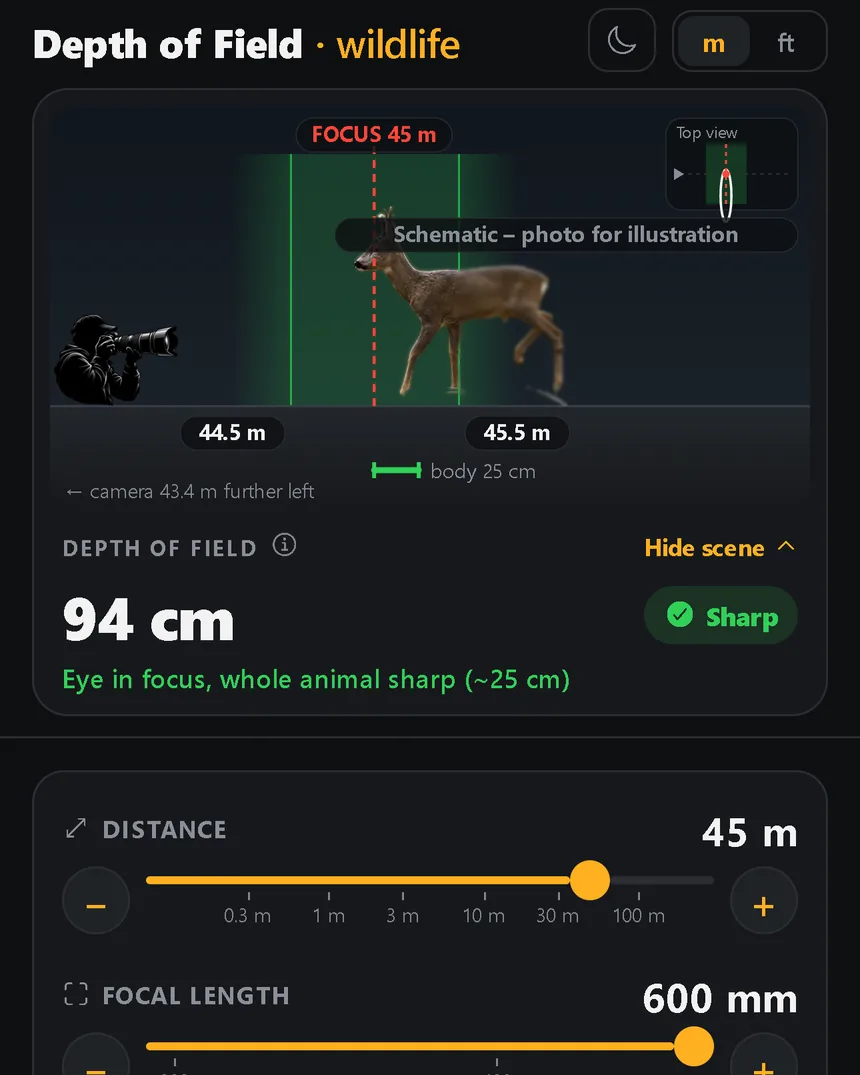
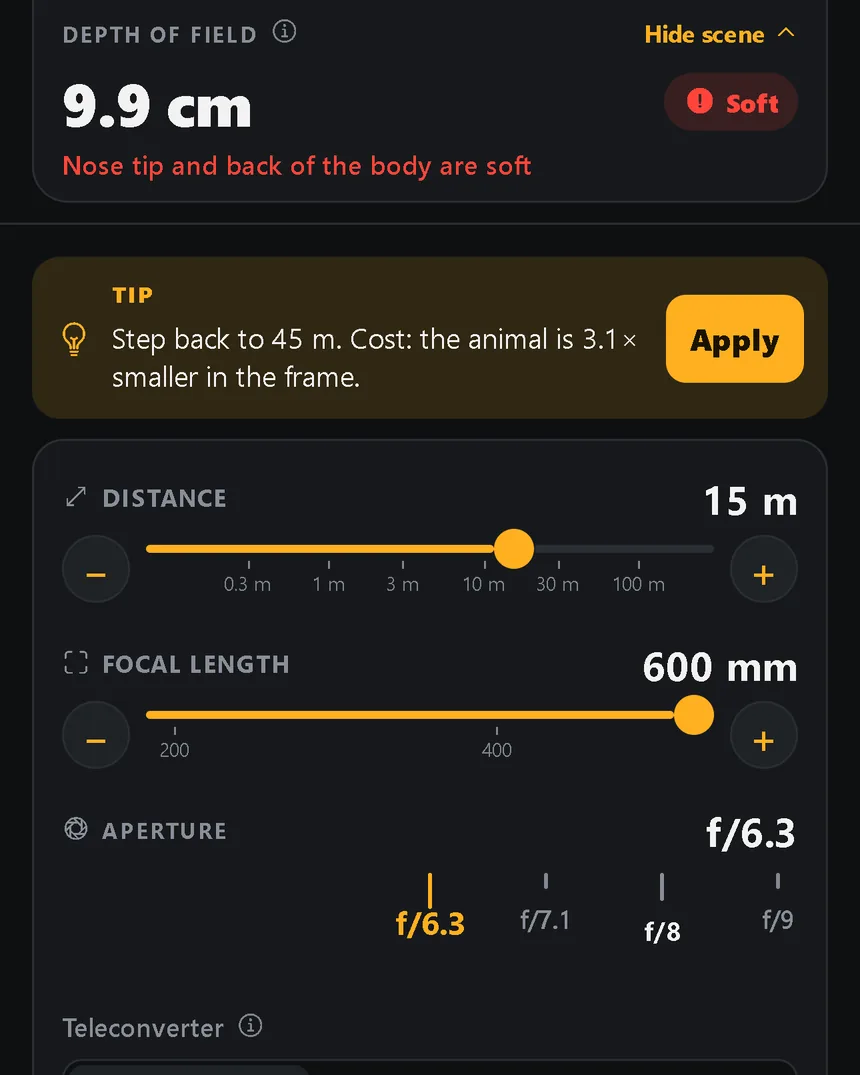
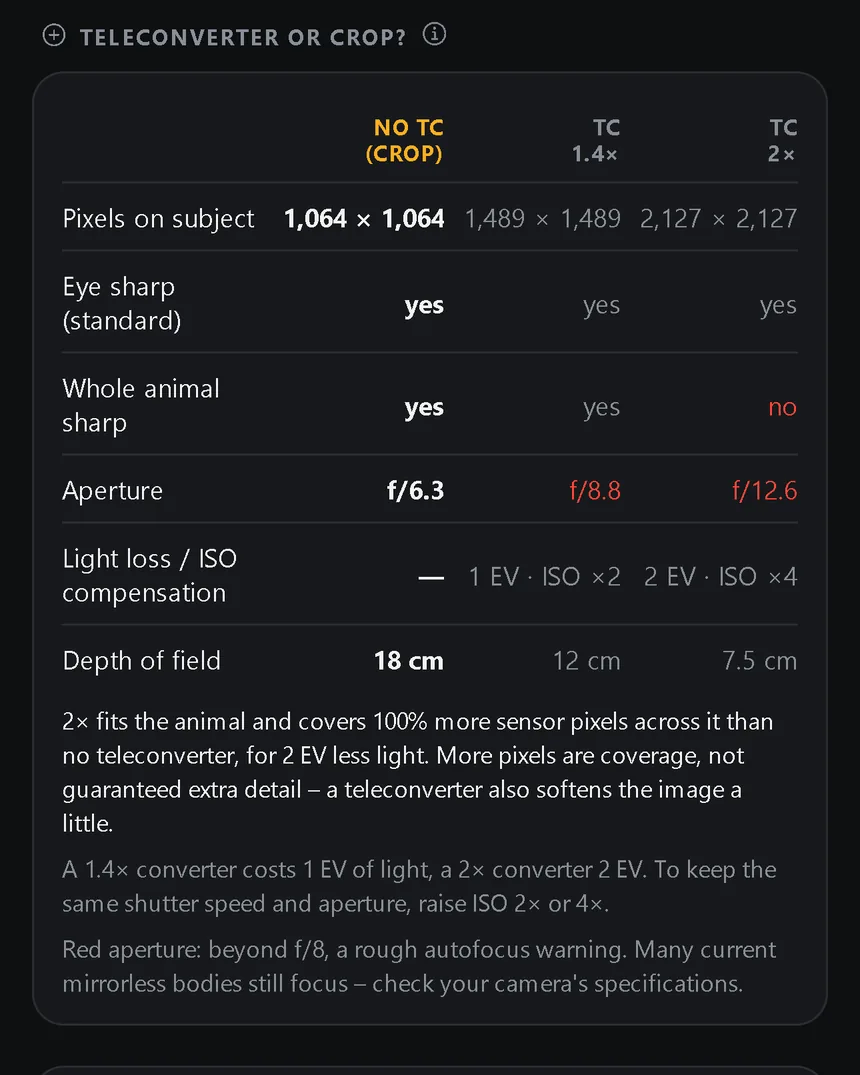
A model you can trust – and its limits
The app uses a thin-lens depth-of-field model calibrated with each lens's published minimum focus distance and maximum magnification, so close-up and macro work (even beyond 1:1) is handled correctly. Diffraction is included, and the result is judged against the sharpness standard you choose (print, cropped 2× or 100% pixels).
It is a model based on manufacturers' catalogue data, not a laboratory measurement of your particular lens. Stabilisation ratings are never added up between body and lens, and you choose how much of the official figure to count on in practice.
Tip for beginners: for a portrait, the eye is what matters. A soft tail is fine – a soft eye is not.